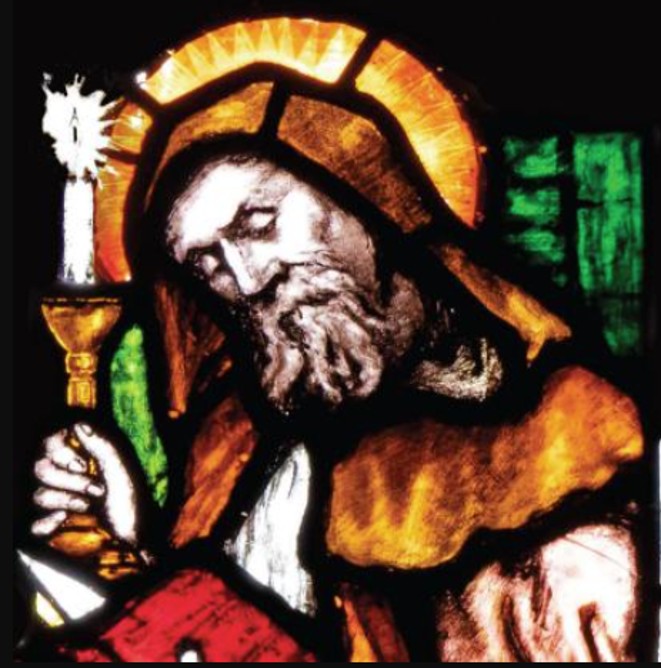
St. Eunan (Adomnán) an Abbot for Synods and change – 23rd September

St. Eunan: image source

Nb* Much of the information here is gleaned from Omnium Sanctorum Hiberniae

Eunan was born at Drumhome near Ballintra in south-west Donegal into the Uí Chonaill family around 624. His Uí Néill lineage aligns with Loingsech, king of Tara. Eunan was educated by Columban Monks and he later joined the Iona community as a a novice in 650 before becoming the ninth abbot of Iona in 679. Eunan also became president-general of all the Columban houses in Ireland. During his term of office, he paid three lengthy visits to Ireland which brought about change.

Notable writings.

Eunan wrote “Vita Columbae” on the life of Columba, highlighting the saint’s virtues. It is full of memorable details of monks and lay people who came into contact with St. Columba. This biographical work is considered a most complete biography in all of Europe from early Christianity through to the late Middle Ages.

Eunan also wrote a book “De Locis Sanctis” on the holy places, such as Jerusalem, Damascus, Constantinople and Alexandria based on descriptions received by a French bishop Arculfus, who had been shipwrecked in western Britain and took refuge in Iona.

The English influence

On two occasions Eunan visited the court of King Aldfrid of Northumbria. Alfrid as a prince, once upon a time lived many years in exile in Ireland, and Eunan became acquainted with him. Prince Aldfrid was then recalled to the throne of Northumbria. In 686, Eunan went to visit King Alfrid to seek the release of Irish captives at that time. The English king gave a ready and favourable response to this demand; “that a complete restoration of the captives should be made [to Eunan], and that no Saxon should ever again go upon a predatory excursion to Ireland’’. Such a favourable response, no doubt cemented good relations that would foster good tidings for Ireland and England as well as the Church universal as we shall consider below…

The universal church context was that Pope Saint Vitalian was elected the 76th Pope of the Holy See in 615. Saint Vitalian was instrumental in strengthening Christianity in England by appointing St. Theodore of Tarsus as the Archbishop of Canterbury. This was particularly influential during the Synod of Whitby in 664, where Northumbrian overlord King Ozvi, in consultation with Rome, accepted the Easter dates observed by the Pontiff, as opposed to the widespread celtic Easter Observance. This agreement would reverberate into Ireland through St. Eunan.

On Eunan’s first English visit in 686, he became aware of unresolved conflicts lingering after the Synod of Whitby (664) regarding Celtic observances of the Easter calendar and the Roman observances in England. Eunan understood that the Celtic observance was was similar to St John which was the custom in the Eastern Church. Two years later Eunan visited the court of Aldfrid again, and presented the king with his invaluable work, “De Locis Sanctis,”. Eunan stayed at various religious homes in the north of England, and he became fully acquainted with the correct computation of the Easter calendar according to the Roman observance. In visiting the monasteries of Wearmouth and Jarrow, St. Eunan had lengthy discourses with the Abbot Ceolfrith.

Intervention between Celtic and Roman observance in the Irish Church

From his experience in England, Eunan would make an important contribution to the church universal regarding an reforming the Celtic practices of the their Easter calendar in Britain and Ireland. St. Eunan felt it would be better for the universality of the Church for the Celtic monastries to make use of the Roman observance. For eighteen years St. Eunan made it his business to convince Ionian monks in Scotland as well as and the Irish Columban monasteries to switch to the roman observance during his office as president. Thus Eunan became a devoted champion of the Whitby Synod. This reform of the Celtic church was a slow progress across Ireland, which was later accelerated by St. Malachy some centuries later.

The law of innocents – a type of old Irish ‘Geneva Convention’

In 697 Eunan visited Ireland a third time, and obtained a decree from the Irish princes that men alone should be subject to military service. This seems to be linked in some way to another notable influence of Eunan; The law of innocents – a type of Irish ‘Geneva Convention’ which was decreed at the Synod of Birr. There he convinced the participants that, women, children and clerics should be exempt from war and not be taken prisoners or slaughtered. This came to be known as Eunan’s law.

In the Laebhar Breac it reads of four chief Irish laws: “Patrick’s Law, that the clerics should not be killed; Bridget’s Law, that the cattle of thy shall not be killed; Eunan’s Law, that women shall not be killed; and the Law of the Lord’s-day, that it be not desecrated.”

Eunan was a man of great austerities and his ascetic life is compared with the great fathers and hermits of the Egyptian deserts. St. Bede refers to Eunan as “a good and a wise man, and remarkably learned in the knowledge of the Scriptures.”

He died at the Abbey in Iona in 704. He is the Patron of Raphoe Diocese. He is celebrated on the 23rd of September.

Facebooktwitterredditpinterestlinkedinmailby feather

St. Ailbe, the orphaned man cub – 12th September

Image source: Pinterest

Original Material Sources for this Saint can be taken from: The ”Acts of St. Ailbe” in the Codex Salmanticensis. The below material has been gleaned mainly from Catholicireland.net

St. Ailbe heralds from Munster. He is a pre-patrician saint, meaning he was evangelising in Ireland before St. Patrick’s mission begun. St. Ailbe is a patron saint of the diocese of Cashel and Emily and is the also patron of wolves. Ailbe is called Albeus in Latin and Elvis in English. St. Ailbe was the first bishop of Emily in the province of Munster and is considered the St. Patrick of Munster.

As a personal opinion, the St. Ailbe’s story somewhat parallels a Disney film called Jungle book, with it’s two main opposing characters of 1) Mowgli, the good ”man cub” reared by a wolf 2) and Shere Khan, a fearsome tiger want’s to destroy Mowgli to protect his own high standing from humanity. Likewise 1) Ailbe is the good ”man cub”, reared by a wolf 2). Cronan is father is the very man who want’s to destroy Ailbe to protect his own high standing in society.

Now Ailbe was born to a maidservant in the house of Cronan, Lord of Eliach, in County Tipperary. Cronan, disapproved of Ailbe’s birth and directed that the new born be abandoned and exposed to ‘dogs and wild beasts, that the child might be devoured’. But, by divine providence, the baby was found hidden under a rock (Ail) and alive (beo), by a she-wolf who then took him and reared him among her own cubs. Ailbe would later repay the kindness toward the end of his life when a she-wolf chased by hunters took refuge with him.

Ailbe in his youth, met and befriended St. Declan, and the two would become disciples of St. Palladius, who came to try to evangelise Ireland, before St. Patrick‘s mission. A work entitled, “The Life of Declan” recounts the great friendship of Declan and Ailbe. They later went to Rome for priestly formation. Some years later, while returning to Ireland from Rome, Declan met Patrick in the north of the eternal city, in a providential encounter, which would have a bearing on Ailbe’s life. “The Acts of St. Ailbe” represent Ailbe as preaching in Ireland before St. Patrick. Ailbe was noted for his charity and kindness, as well as his eloquent sermons. He was a missionary in Ireland under King Aengus of Cashel. It was this same king that St. Patrick converted. Ailbe was Abbot, bishop and preacher and became a disciple of St. Patrick, according to St. Patrick‘s biographer, Tirechan. It’s quite possible to be both a disciple of Palladius, and Patrick. After all, St. Andrew was a disciple of John the Baptist, before he became a disciple of Jesus. Again this is a personal opinion.

St. Ailbe’s monastery of Emily, known as Imleach Iubhair (the lakeside at a yew tree) went on to become one of the most important ecclesiastical sites in Munster and in later centuries Emily was re-established a Diocesan centre, after the synods of Rath Breasail and the Synod of Kells. The ecclesiastical monastic site was located at the modern Catholic church and graveyard at Emily.

St Ailbe’s holy well can be found in the north-eastern corner of the graveyard. In 1898 the well supplied the surrounding village. Local memory and historical sources say that in the past the pilgrimage rituals were focused on the holy well and an early medieval cross, known as St Ailbe’s Cross. The cross is located a short distance from the well. The cross was also said to cure back pain. When a person has a pain in his back he would get it cured by putting his back against the stone while praying to St Ailbe.

The repose of Ailbe of Imlech Ibuir is recorded as 528 by the Annals of Ulster (within the old monastic grounds). St. Ailbe feast day is celebrated in the Irish liturgical calendar on September 12th.

Facebooktwitterredditpinterestlinkedinmailby feather

The synod of Rath Breasail and the re-establishment of former Irish diocese.

The historical context of ancient Ireland.

Ireland was always outside the Roman Empire, due in part to a successful strategy, whereby the Gaelic kings would take hostage, of sons and daughters of nobility, of an invading menace. “Niall and the Nine Hostages” for example gives an insight into this tried and tested method of national defence. St. Patrick and his two sisters where taken hostage by King Niall along with thousands of other victims.

St. Patrick’s apostolic mission to Ireland.

When St. Patrick returned to Ireland on his apostolic mission much later in life, he established dioceses as one would expect. But some centuries after this, a lay administration, known as the ‘’coarb’’ of St. Patrick developed. This admin role was a family heirloom, as a family member took control of the administration of their abbacy, to keep the monastic settlement from the foreign Viking hands. This followed as a result of the historic period of great instability in the Gaelic kingdom. In that epoch, there were seismic ethnic incursions in Ireland, that we find narrated in the ‘’Book of Invasions’’. This book encapsulates a difficult situation for the Gaels, wrought by the Vikings, who as the book recounts, arrived in Ireland ‘’wave after wave after wave’’. The Norse Vikings took hold of Dublin and Waterford, and later the Danes arrived and despoiled the established Catholic sees in Ireland. It was St. Kelly of Armagh who first challenged the family heirloom ”Coarb” model in favour of Rome Rule.

The various synods that changed the ecclesial norms in Ireland

The nation’s formerly established diocese became depleted of bishops and priests. A monastic model eclipsed the diocesan model, and this lasted until the time of the Synod of Rath Breasail of 1111. The Gael’s even had a Celtic observance that declined in favour of the Roman observance after the Synod of Whitby in 664 called by the King of Oswiu in Northumbria. St. Laserian took the leading part in settling the Irish Easter calendar controversy. In the Synod of Magh-lene, he successfully defended the Roman Easter calendar computation. The final break from the Celtic observance to the Roman observance however came slowly, with further persuasive efforts of St. Eunan.

The history and changes brought by the Synod of Rath Breasail

The year 1631 saw the completion of Fr. Geoffrey Keating’s series of moral reflections on death and the conduct of human life, Trí bior-ghaoithe an bháis, and his treatise on the Mass, Eochair-sgiath an Aifrinn. A man called John MacErlean draws attention to the inclusion of significant early ecclesiastical records which would otherwise have been lost. Keating’s history is the only source for the Synod of Rath Breasail at the beginning of the twelfth century when Ireland was first divided into its modern dioceses format we have today.

The Synod of Rath Breasail re-established diocese under the seat of the bigger and more notable monasteries existing in Ireland at the time. The lesser monasteries became subsumed by the more important monastic centres within the confines of the newly established diocesan lines. For example we had the Lismore monastery which was an important centre of learning for the Gaels. The lesser known monasteries became more like parochial centres. Shortly after the death of diocesan promoter St. Malachy, the Synod of Kells followed in 1152 to iron out anomalies still extant, and the four archdiocese in Ireland came into effect. The Waterford diocese was a small diocese of mainly Danish folk and some members of the Déise folk. Lismore and Waterford were then separate diocese as the peoples where still so culturally diverse. It was only much later did the two diocese amalgamate, and Lismore being the bigger diocese was given the lead name of the Lismore and Waterford diocese. After the reformation period the names were switched to the Waterford and Lismore diocese, which still stand today.

Facebooktwitterredditpinterestlinkedinmailby feather