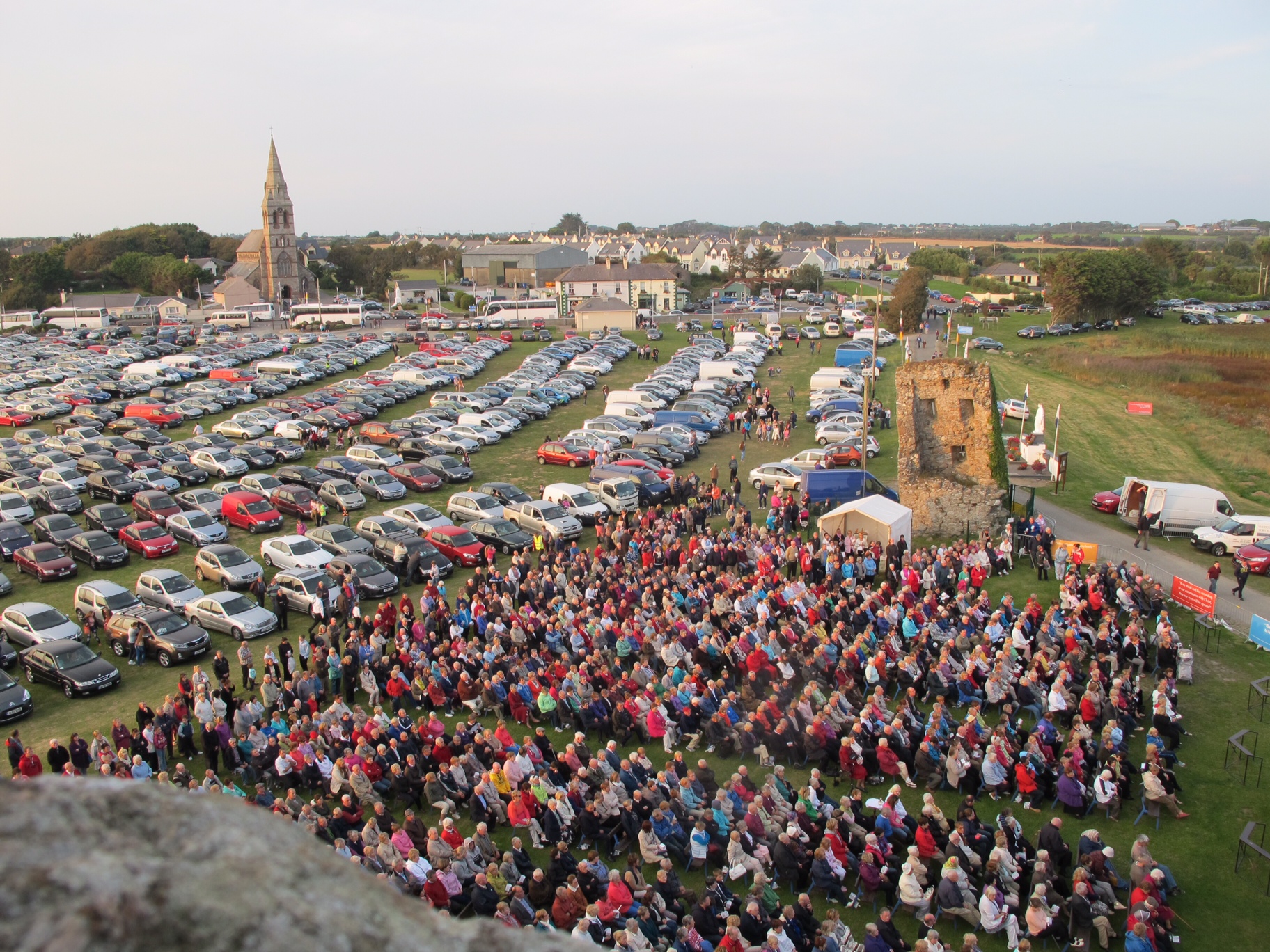
Photo taken from Catholic Ireland

Much of the material here is distilled from History of Our Lady’s Island
Tradition attests that Our Lady’s Island as a religious settlement was founded by St. Abban, who is the nephew of St Ibar, who is one of the four pre-patrician missionaries to Ireland; in that they evangelised some part of Ireland before the arrival of St. Patrick on his apostolic mission.
Our Lady’s Island has been a place of pilgrimage and of devotion to Our Lady since around the year 600 A.D. With the Norman Invasions in the late 12th century, Our Lady’s Island fell into the possession of Milo De Lamporte, given to him by Strongbow. Milo’s son Rudolph gave Our Lady’s Island to the Augustinian fathers in 1184, as he witnessed the constant influx of pilgrims there. Even in his days, the pilgrims would continue to arrive, and a number of them would be travelling from as far north as St. Patrick’s purgatory at the shrine of Lough Derg. Rudolph himself later went to Israel as a ”Crusader”, where he was killed.
Our Lady’s island was later granted the Bula of Pope Martinus V (1417-1431), granting indulgences to pilgrims. Later again, in 1607, Pope Paul V granted to ”Our Lady’s Island” a Plenary Indulgence to the faithful who after Confession and Holy Communion would do pilgrimage to the Church of Our Lady’s Island on the 15th August, the feast of the Assumption. or the 8th September, the Feast of the Nativity of Our Lady.
The shrine suffered a crisis on the 4th October 1649, when the soldiers of Oliver Cromwell arrived on Our Lady’s Island. They burned the priory, and massacred several monks and desecrated the church. A young lad named Duffy salvaged a crucifix from the altar of St Ibar’s church, but he was taken down by a bullet as he was crossing the shallow waters to the mainland. The crucifix lay in the lake bed until 1887 when it was discovered and brought to the parish priest, the Venerable Archdeacon Roche. Despite the crisis from Cromwell’s visit, the shrine continued to witness many pilgrims there.
During the Penal laws of the eighteenth century, Pope Benedict XIV (1740 – 1758) suppressed some Irish pilgrimages while specifically exempting Lough Derg and Our Lady’s Island. When evangelising the culture, the pope’s instructed the Irish missionaries of St. Patrick’s line to elevate the culture. In this aspect, we encompass the chiefly Gaelic, as well as Norman, and Viking cultures present in Ireland.
More recently in history, in 1954, the celebrated Fr. Patrick Peyton came to address pilgrims at Our Lady’s Island on his last Crusade. On the ruins of Rudolph’s old Norman castle, was fittingly constructed an altar. From this altar, Fr. Peyton gave his rallying address, on his twenty first Irish rally. His customary address was the renowned slogan, the family that prays together, stays together.
We give thanks to Our Lady for bequeathing Ireland with two recognised Marrian Shrines, one in Knock and the other at Our Lady’s Island. Both equipped to take pilgrims in great number. Let us remember Our Lady, Our Queen and ask through her intercession for the grace to undergo pilgrimage to venerate Our Mother and Queen, for God’s glory and the salvation of souls.


 by
by 