
Picture taken by Fr. Paul (IVE) in early July 2025
Nb* Much of the information here is taken from the book ‘’’Declan’’ by Liam Suipéil, published in 2020; however text marked by […] is taken from CELT project: Life of St. Declan of Ardmore
Declan was one of four pre-patrician saints (along with Ailbe of Emly, Ciarán of Saigir, and Abbán of Moyarney) who preached the Gospel along Ireland’s south coastal regions, before Patrick arrived in Ireland on his apostolic mission.
We have a latin account of Declan’s life called ”Vita Declani” in which we can learn much about this distinguished Irish saint. Declan is the patron of the Waterford & Lismore diocese, in the ancient territory of the Déise people. His parents were of noble blood and his father’s line extended back to King Tuathal Teachtmhar in the 1st century: In that era, a dispute happened at the Royal Seat of Tara, where the Déise tribe were expelled from the Royal Province of Meath. One part of the Déise tribe were was exiled to the South West Wales, settling in Meniva. The other part of the Déise tribe moved south to Tipperary & Waterford, and it is from this tribe that remained in Ireland, that Declan comes from.
Declan was born around 373 A.D at Dromroe between Lismore and Cappoquin, to his father Erc Mac Trein and mother Déithin. [On the night of Declan’s birth a wondrous sign was revealed to all, that is to the people who were in the neighbourhood of the birthplace; this was a ball of fire which was seen blazing on summit of the house in which the child lay, until it reached up to heaven and down again, and it was surrounded by a multitude of angels. It assumed the shape of a ladder]. After the birth of St. Declan, a holy priest called Colman, baptised the child and explained to his parents that he was blessed by God. Declan was then fostered, trained and educated by his Uncle Dobhrán, for seven years. As Declan grew older, he was sent to a holy man named Dioma to further his studies. From this point onwards, Declan’s reputation grew and many followed him as disciples.
Around the year 395, he travelled to Rome via Gaul, now France, for further studies. At Rome, he met and became friends with Ailbe, the future bishop of Emly. Humble Ailbe is considered the Patrick of Munster. [At the same period there was a holy bishop, i.e. Ailbe, who had been in Rome for a number of years before this and was in the household of Pope Hilary by whom he had been made a bishop. When Declan with his disciples arrived in Rome Ailbe received him with great affection and gladness and he bore testimony before the Roman people to his Declan’s sanctity of life and nobility of blood. Declan therefore received marks of honour and sincere affection from the people and clergy of Rome when they came to understand how worthy he was, for he was comely, of good appearance, humble in act, sweet in speech, prudent in counsel, frank in conversation, virtuous in mien, generous in gifts, holy in life and resplendent in miracles]. During Declan’s stay in Rome, he was ordained priest and bishop by the pope of the time. While still in Rome, as he began his pilgrim journey back to Ireland, he met Patrick, Ireland’s future patron. They became providentially acquainted during this encounter. [On the road through Italy Bishop Declan and Patrick met. Patrick was not yet bishop, though he was to be a bishop subsequently by Pope Celestinus. They bade farewell to one another and they made a league and bond of mutual fraternity. They went on their way; Declan to Ireland and Patrick to Rome]. Today, St. Declan is considered “the Patrick of the Déise.
St. Declan went on to establish a monastery Ardmore (meaning great height), which grew into a large town. He became one of the pre-eminent figures in the early Irish Church.
Anecdotes of St. Declan.
Declan’s monastery at Ardmore has long been a place of pilgrim significance, with large crowds that gather every year for his feast day on July 24. The story behind this pilgrim, has it roots in a religious and political meeting: Declan and Patrick met at Cashel, where Patrick had established a diocese. This ancient meeting is commemorated today in a long-distance trail known as St Declan’s Way. In the 5th Century, St Declan walked 110 km from his monastery in Ardmore, Co. Waterford to visit St Patrick in Cashel, Co. Tipperary, where Patrick was resident at the time. Patrick had been appointed a bishop by pope Celestinus and at that time of Declan’s arrival, Patrick was preaching and converting the King of Cashel Aongus Mac Natfrich to Christianity. At baptismal ceremony, St. Patrick accidently pierced the kings foot with his holy sceptre. It’s a famous story… Around the same time, a king named Ledban, who ruled the Déise people, proved himself antagonistic towards Christianity. There was a persecution brewing, and so an Angel of the Lord appeared to St. Declan to tell him that he must make a journey towards Cashel before matters escalated. Declan made his way over the Knockmealdown mountains, passing through Mount Melleray, Lismore, Ardfinnan, Cahir and met Patrick at at the hill of Inneonach or Mullach Inneonach.
Now Mullach Inneonach,was an important inaugural site for Déise kings at the time. It is just a field today with cattle, and can be found with a sign explaining the historic meeting between Patrick and Declan. The field is just off the R687 road spur from the N24 not far from Clonmel.
[The angel of God came to Declan and said to him “Go quickly to Patrick and prevent him cursing your kindred and country, for to-night, in the plain which is called Inneoin, he is fasting against your king Ledban, and if he curses your people they shall be accursed for ever.” Thereupon Declan set out in haste by direction of the angel to Inneoin, in the northern place of the Decies. When Patrick and his disciples heard that Declan was there they welcomed him warmly and received him with great honour. But Declan made obeisance to Patrick and besought him earnestly that he should not execrate his people and that he should not curse them nor the land in which they dwelt, and he promised to allow Patrick do as he pleased. And Patrick replied:—“On account of your prayer not only shall I not curse them but I shall give them a blessing.” Declan thus went to King Ledban and promised rewards to him if he would go to Patrick to receive baptism at his hands and assent to the faith. But Ledban, was obstinate in his infidelity and in his devilry. Declan turned to the assembly and addressed them:—“Separate yourselves from this accursed man lest you become yourselves accursed on his account, for I have myself baptised and blessed you. Declan added that St. Patrick, whom God has sent, will bless you, for he has been chosen Archbishop and chief Patron of all Erin. At this speech they all arose and followed Declan who brought them into the presence of Patrick and said to the latter:—“See how the whole people of the Deisi have come with me as their Lord to thee and they have left the accursed prince whose subjects they have been, and behold they are ready to reverence you and to obey you for it is from me they have received baptism.” At this Patrick rose up with his followers and he blessed the people of the Deisi and not them alone, but their woods and water and land. Whereupon the chiefs and nobles of the Deisi said:—“Who will be King or Lord over us now?” Declan then appointed was Feargal MacCormac a certain young man of the nation of the Deisi who was a kinsman of Declan himself. Declan set him in the midst of the assembly in the king’s place and he was pleasing to all. Whereupon Patrick and Declan blessed him and each of them apart proclaimed him chieftain. Patrick moreover promised the young man that he should be brave and strong in battle, that the land should be fruitful during his reign].
The new king Fergal was grateful for the blessing of Patrick and of Declan, and offered Patrick a well with some land just outside Clonmel town. The prophecy is that the lands will never fall from the Churches hand, and this prophecy is still being fulfilled today on the site of St. Patrick’s Well.
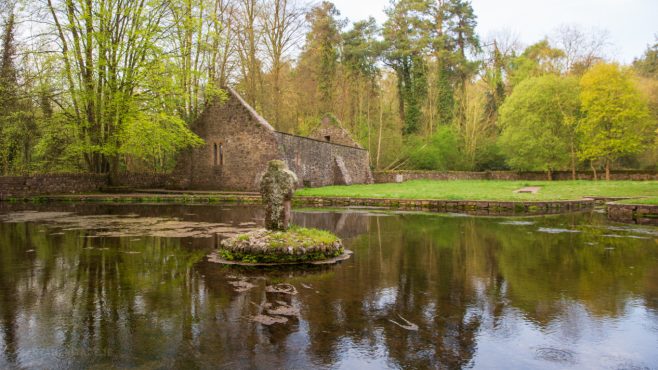
Image source: St. Patrick’s Well – Our Irish Heritage
Another anecdote
At Declan’s monastery, there was an imminent naval attack threatening Ardmore. This attack was averted when Declan asked St. Ultan to intervene. Ultan raised his left hand against the attackers and the sea engulfed them. Declan and Ultan disputed the originator of the miracle, but the saying holds sway today in Ardmore “[May] the left hand of Ultan be against you’’.
[When Declan realised that his last days were at hand, his disciples brought him back to his citadel Monastery, for Declan dwelt in a small venerable cell, built in a quiet place near the sea called Diseart Decláin (Declan’sHermitage). Before he died, He received the body and blood of Christ and he blessed his people, his dependents…]
NB* this last paragraph is taken from Canon Donal O’Connor’s book -‘The Pilgrim’s Round of Ardmore’ Co. Waterford 2000.


 by
by 