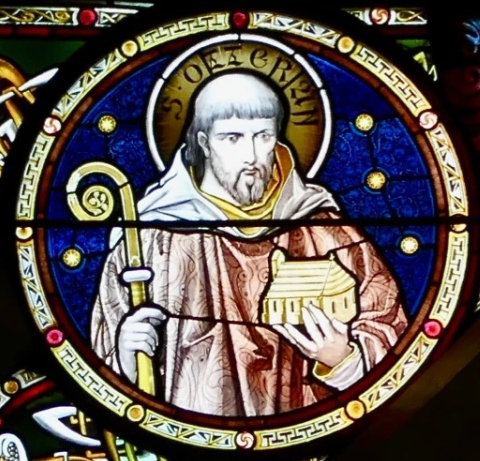
Image Source from Roaringwater Journal
Material taken from Saint of the Day, Saint for a Minute, DBpedia: Naomh Odhrán (as Gaeilge) and also from St. Eunan’s writing on St. Columba.
Otteran (Odhran, = `the pale faced one’) was of royal Irish lineage and was a kinsman of St. Colm Cille of Tír Conaill (present day Co. Donegal) in the 5th century. He became a monk and dedicated his life to prayer, study, and the spread of Christianity. Saint Otteran is remembered for his deep piety and devotion to Christ. His exemplary faith and virtuous character drew others to him, and many sought his spiritual guidance and counsel. He was known for his humility, his love for the poor, and his willingness to serve others.
Saint Otteran (Odhrán) lived in Co. of Meath. He spent over forty years in Béal Átha Gabhan or Silvermines in North Tipperary, where he founded a monastery in 520. It is said that up to 3,000 students were studying there. Only the ruins and a cemetery remains today. Not less than a kilometre away, we find a well with a small stream. This well is dedicated to Otteran with the name Tobar Odhrán. There is an annual pilgrimage on the 15th of August in which Holy Mass is celebrated. It is said that the well water cures eye problems. Otteran is the patron saint of the parish of Latha Gabhann, County Tipperary, and the locals are proud of their ”Odhráin” Heritage.
Otteran may have visited Iona, before Colm Cille‘s mission there had properly begun. He was among the twelve who went with St. Colm Cille to Iona island. This place was part of the ancient Gaelic kingdom, the Dála Riada; a kingdom that included the north-east of Ireland and parts of the western of Scotland. Shortly after he came to the island, Otteran felt that his days were coming to an end. Before Otteran died, Saint Colm Cille promise him that whoever prays to Colm Cille will not receive anything unless similar prayers seeking Otteran’s intercession are also requested.
After Otteran passed away, Colm Cille is said to have seen devils and angels fight over Odran’s soul before it ascended into heaven. A popular legend also says that Otteran consented to being buried alive beneath a chapel that Columba wanted to build. It was part of an omen that the walls of the chapel would collapse unless a living man was buried below the foundations. So, Otteran was consigned to the earth, and the chapel was erected above him. It is a difficult legend to believe, and there must be more to this story to make sense of it.
The oldest remaining church on Iona is named after St. Otteran located by his tomb, called Reilig Odhráin. An Irish Calendar from 800 A.D. written by Oengus the Culdee testifies his death. Otteran is mentioned to be the first monk who died on the missionary island. He was the first Christian to be buried in the old pagan cemetery on Iona.
Otterran is ‘’Titular Guardian’’ of Viking ancestors’ ashes.
The vikings had long carried their deceased leaders to be buried on the island. Iona is the place of repose for over fifty kings and a handful of princes. The norsemen thus chose Otteran (the viking pronunciation), with the titular guardian of their ancestors’ ashes, and patron of Waterford city in 1096.
The Irish Martyrologies tell us that saint Otteran is honoured on October 27th as a monk of Hy, a kinsman of St. Colm Cille. Otteran died in 548 AD and his tomb is greatly revered in Iona. He is recognised as a saint through the process of Cultus confirmation (equipollent canonization) since 1902 by Pope Leo XIII


 by
by 